
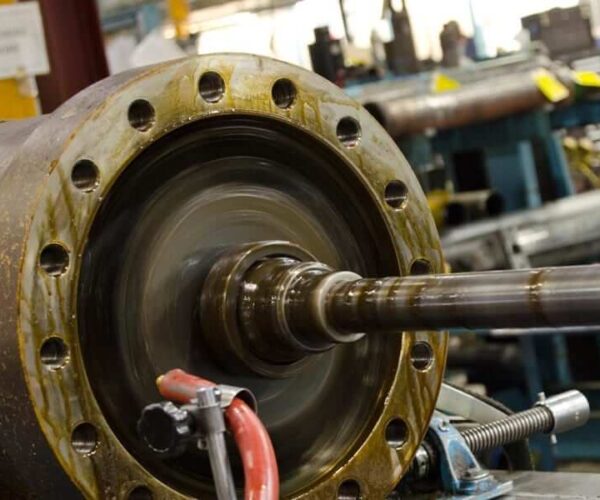
Precision Honing Process
Cylinder honing is a critical procedure that can enhance the efficiency and dependability of your Cylinder. It entails the removal of a minimal amount of material from the inner cylinder surface to achieve a consistent surface finish. Within this article, we will delve into the significance of cylinder honing, the optimal timing for its application, and distinctions between honing and sharpening. Furthermore, we will address frequently asked questions concerning cylinder honing to offer a deeper understanding of this process.
The primary objective of honing is to achieve precise geometric concentricity and parallelism throughout the length of a round tube, refining its inner surface. We specialize in honing tubes ranging from 12 mm (0.5″) to 500 mm (19.5″) in diameter, with lengths of up to 10 meters (32′.5″).
We provide internal honing, catering to the specific needs of hydraulic cylinder manufacturers. Honing any tube to a fine, smooth finish results in a distinctive “crosshatch” pattern on the honed surface.
When welding cylinder tubes, material distortion can occur. To address this, we provide a complimentary post-weld honing service. Our customers have the option to receive either honed or unhoned material. After machining and welding, the material can be sent back to us for the final honing process. This guarantees the highest possible tolerances for welded cylinders.
FAQ
What is the purpose of honing a cylinder?
The primary objective of cylinder honing is to enhance the surface finish of the cylinder wall. Achieving a smooth surface finish is vital as it facilitates the proper seating of piston rings, ensuring a secure seal. This seal is essential for optimal compression, power generation, and the prevention of oil infiltration into the combustion chamber.
Additionally, honing serves to address minor damage or wear on the cylinder wall, effectively restoring the correct shape and dimensions of the cylinder.
When should you hone a cylinder?
Cylinder honing is commonly performed during cylinder rebuilds or repairs. It is also advisable if you detect any indications of cylinder wear or damage, such as diminished compression or excessive oil consumption. Honing plays a crucial role in reestablishing the correct surface finish and shape of the cylinder, ultimately enhancing cylinder performance and prolonging the cylinder’s lifespan.
Do You Hone Cylinders Wet or Dry?
Cylinder honing can be carried out in two ways: wet or dry, depending on the honing equipment and the operator’s choice. In wet honing, a honing oil or coolant is applied to cool the cylinder and provide lubrication to the honing stones, preventing overheating and minimizing friction. Conversely, dry honing does not involve any liquid coolant or lubricant. It often offers a faster process but can produce additional heat and friction, potentially leading to cylinder distortion or even cracking.
Can you just replace Piston seals without Honing?
While there are instances where piston seals can be replaced without honing the cylinder, it is generally advised to perform honing during any cylinder rebuilding or repair process. This holds true even if there are no visible indications of cylinder wear or damage. Honing serves to establish an improved seal between the piston seals and the cylinder wall, leading to enhanced cylinder performance and reliability.